






 Settings
 Fast Delivery
 Free Shipping
 Incoterms
 Payment Types


 Marketplace Product


The Gas Discharge Tube: An “Ancient” Protection Component Extends Its Versatility
Circuit protection is like insurance: you don’t need it until you do, and then you’re relieved to have it. This protection falls into two broad categories: protection against overcurrent, such as via a fuse, and overvoltage, using devices such as metal oxide varistors (MOVs) and gas discharge tube (GDT) surge arrestors (Figure 1).
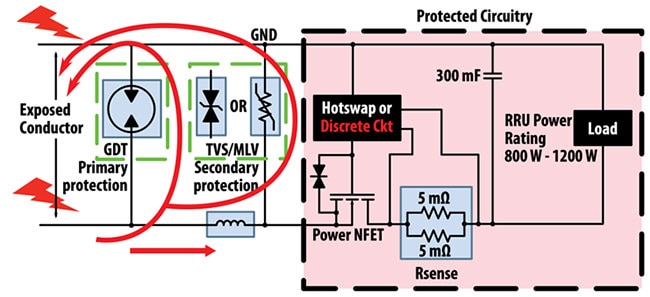 Figure 1 : A GDT can be used for overvoltage protection on its own or in conjunction with other overvoltage and overcurrent devices. (Image source: Bourns, Inc.)
The idea of gas discharge tubes (GDTs) and their conductive points may conjure up images from Frankenstein movies with large, bulky components and assemblies, creating dramatic, highly visible sparks. However, GDTs for circuit protection are quite small, and two-electrode versions are easily placed between the line or conductor to be protected (usually an AC power line, I/O port, or another exposed conductor) and system ground.
These GDTs provide near-ideal functionality by diverting higher overvoltages to ground. In normal operating conditions, the gas inside the device acts like an insulator, and the GDT does not conduct current; it is as close to invisible to the circuit as a non-ideal component can be, with multi-gigaohm impedance when not activated and just a few picofarads (pF) of parasitic capacitance.
However, when the voltage across the terminals exceeds the device’s sparkover voltage, the gas in the GDT becomes fully ionized and no longer functions as an insulator. Instead, conduction across the device terminals occurs within a fraction of a microsecond (Figure 2). The crowbar effect of the GDT effectively limits the overvoltage to a low level and shunts the associated current flow or surge away from downstream components and circuitry.
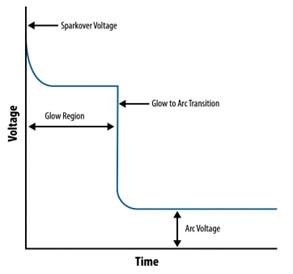 Figure 2 : When the overvoltage limit is exceeded, the GDT gas ionizes, and the device goes from a near-infinite impedance to a highly conductive path in less than a microsecond. (Image source: Bourns, Inc.)
When the surge event subsides, and the system voltage returns to normal levels, the GDT will return to its high-impedance (off) state. As an added benefit, GDTs are non-polarized (bi-directional) and don’t wear out with repeated sparkover events, unlike some other voltage-protection devices.
Despite their age and the antique status of their spark-gap principles, beginning with Benjamin Franklin and his kite experiment (1752) and Humphrey Davy’s use of spark arcing (early 1800s), GDTs are still very viable. They are continuously evolving to meet the needs of today’s circuits and systems.
The usual figure cited for sparkover voltage in air is 30 kilovolts/centimeter (kV/cm). By adjusting electrode spacing and other factors, GDTs can be constructed with flashover voltages ranging from under 100 volts to 1000s of volts.
GDT improvements continue
For example, the GDT28H series of next-generation, high-current GDTs from Bourns, Inc. significantly improves protection from voltage transients caused by lightning and other AC power-line disturbances. Their high surge-current rating provides an enhanced level of voltage limiting during fast-rising events while maintaining a compact size.
These two-electrode, high-voltage gas discharge tubes offer high insulation resistance and are available in a DC sparkover voltage range of 1 kV to 3.3 kV with a 5 kiloampere (kA) surge-current rate. Unlike the dramatic spark gaps seen in movies, these GDTs are fully enclosed devices, and all family members are housed in an 8 × 6 millimeter (mm) through-hole, axial-leaded cylindrical package with a capacitance under 1.5 pF (Figure 3).
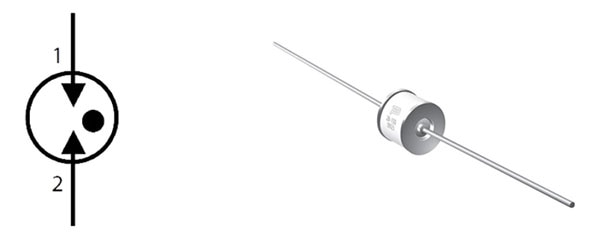 Figure 3: The schematic symbol of a two-electrode GDT (left) represents the small, cylindrical-packaged devices in the GDT28H series. (Image source: Bourns, Inc.)
Among the targeted applications are power supplies, lighting, HVAC, and products that must adhere to IEC 62368-1:2018. This widely used safety standard applies to electrical and electronic equipment in audio, video, information and communication technology, and business and office machines with a rated voltage under 600 volts.
The UL-approved GDT28H series is especially suitable for use in AC isolation situations. It achieves this performance through its extended operating voltage range, high insulation resistance, and heightened surge rating. Additionally, the GDT28H series offers a wide operating temperature range of -40°C to +125°C, making it well-suited for applications in harsh conditions.
One family member is the GDT28H-200-A, a 2000 ±400 volt GDT. As with all members of this family, it features a 5 kA nominal 8/20 microsecond (µs) impulse discharge rating. The impulse sparkover voltage is 2500 volts (maximum) at 100 volts/µs, and 2750 volts at 1 kV/µs.
For designers who need to assess these GDTs, Bourns also offers the DK-GDT28H-01 Design Kit. This kit includes 20 GDTs from the series consisting of 4 devices, 5 pieces each of 1000, 1500, 2500, and 3300 volts DC typical sparkover voltage.
The GDT function is an excellent example of engineers using a fundamental physics principle in different and contradictory applications. While GDTs are fully enclosed and used to crowbar an overvoltage to ground, the spark plug of an internal combustion engine uses an exposed flashover to ignite the gasoline-air mixture in the engine.
Here’s the dichotomy: for the GDT operation, the sparks result from unpredictable overvoltage events, but for the spark-plug function, the sparks are deliberately triggered with precise timing.
Conclusion
Protecting a circuit’s components against overvoltage and overcurrent events is essential to a system’s design. GDTs quickly shunt transients to ground, thus preventing excessive voltage from reaching, damaging, or destroying downstream components. Bourns adds to the utility of these devices by developing them to handle a wide range of overvoltage values and associated surge currents in a tiny, cylindrical package that meets all relevant regulatory standards.
Related Content
1: IEC 62368-1 Is on Its Way: The New Safety Standard for ICT and AV Equipment
2: The Right Power Supply is Critical to Meet the New IEC/UL IEC-62368 Consumer Product Safety Mandate
3: How to Select and Apply IsoMOVs for Maximum Voltage-Surge Suppression with Minimal Space
4: How to Apply Hybrid AC Surge Protection Devices for Improved Surge Protection
About this author

Bill Schweber is an electronics engineer who has written three textbooks on electronic communications systems, as well as hundreds of technical articles, opinion columns, and product features. In past roles, he worked as a technical web-site manager for multiple topic-specific sites for EE Times, as well as both the Executive Editor and Analog Editor at EDN.
At Analog Devices, Inc. (a leading vendor of analog and mixed-signal ICs), Bill was in marketing communications (public relations); as a result, he has been on both sides of the technical PR function, presenting company products, stories, and messages to the media and also as the recipient of these.
Prior to the MarCom role at Analog, Bill was associate editor of their respected technical journal, and also worked in their product marketing and applications engineering groups. Before those roles, Bill was at Instron Corp., doing hands-on analog- and power-circuit design and systems integration for materials-testing machine controls.
He has an MSEE (Univ. of Mass) and BSEE (Columbia Univ.), is a Registered Professional Engineer, and holds an Advanced Class amateur radio license. Bill has also planned, written, and presented on-line courses on a variety of engineering topics, including MOSFET basics, ADC selection, and driving LEDs.

Have questions or comments? Continue the conversation on TechForum, DigiKey's online community and technical resource.
Visit TechForum









 Netherlands