






 Settings
 Fast Delivery
 Free Shipping
 Incoterms
 Payment Types


 Marketplace Product


Spartan Edge Accelerator Board
Target users
- Professors
- DIY Engineers
- Makers
- FPGA Developers
- Students
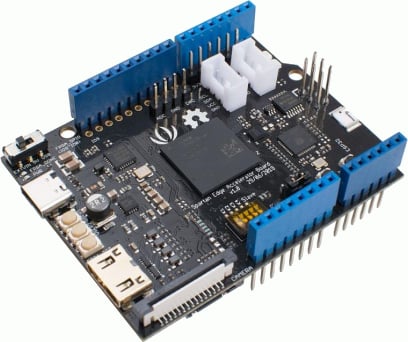
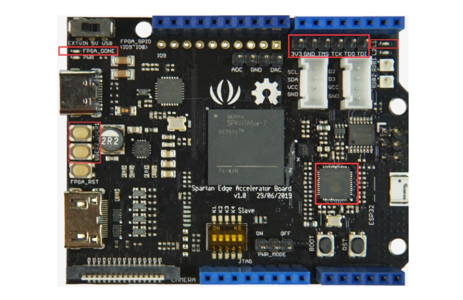
The Spartan Edge Accelerator Board (SEA Board in short) is a lightweight FPGA development board, it is based on the Xilinx Spartan-7 chip and follows the Arduino shield form factor. Hence, you can use it as an Arduino shield to driver an LCD and a camera or as a stand-alone FPGA development board. Besides, with the help of on-board ESP32 chip, the SEA board also enables your Arduino with WiFi and Bluetooth function.
Spartan-7 is the newest and most cost-effective FPGA chip among Xilinx’s FPGA family, offers the best in class performance per watt. On top of that, we provide the full FPGA APIs for Arduino, which means Arduino users are able to use the FPGA function without knowing anything about FPGA. This board will broaden Arduino’s capability in many ways like simple image processing and computer vision application, signal encryption and decryption, and signal sampling and processing.
- Features
- Specifications & Board Peripherals
- Get Started & Reference Designs
Features
- Integrated mipi, mini HDMI interface
- Supports Raspberry Pi camera v1.0 (OV5640)
- Maximum support for 30fps image transmission
- IoT WiFi and Bluetooth with ESP32
- Support AWS, Azure and other cloud services
- Support software encryption algorithm
- 20 user-defined extended I/O ports(Stand-alone mode)
- 10 user-defined extended I/O ports(Arduino shield mode)
- Full FPGA APIs for Arduino
- 8-bit ADC & DAC
- 6-axis accelerometer & gyroscope
- 2 user RGB LEDs & buttons
- Arduino Shield Mode
- FPGA Stand Alone Mode
Applications
- MIPI camera input and HDMI output Vivado engineering
- On-board LED, DIP switch, ADC and DAC reference case
- Onboard gyroscope case
- Provide GPIO/UART/ADC/DAC/RGB-LED expansion for Arduino
- Signal generator case (requires Arduino configuration)
- ESP32 controlled signal generator case
- Use the AWS GreenGrass IoT platform case
- Color recognition and object tracking case
- Graphic recognition case (triangle, circle and square recognition)
- Digital Character Recognition Case
- AES encryption and decryption algorithm implementation in FPGA
- Implementation of the PID algorithm in the FPGA

Spartan Edge Accelerator Board
DigiKey Part Number: 1597-102030005-ND
ESP32, XC7S15 FPGA Embedded Arduino Platform Evaluation Expansion Board
FPGA Specifications
Attention
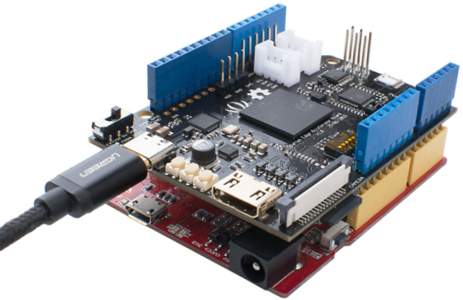
The SEA shield's IO voltage is 5V, and the FPGA's IO voltage is 3.3V, so we made a voltage divider to make the IOs voltage compatible. The 3.3V IO voltage of the SAM D21 series will be less than 3.3V after voltage division, which is not enough to drive the FPGA's IO. Therefore, at present, the SEA development board only supports the 5V IO Arduino board, such as Arduino UNO and Seeeduino V4.2.
| FPGA Chip | Spartan-7 XC7S15 | Logic Cells | 12,800 |
|---|---|---|---|
| Slics | 2000 | CLB Flip-Flops | 16,0000 |
| Max. Distributed RAM (Kb) | 150 | Block RAM/FIFO w / ECC (36 kb each) | 10 |
| Total Block RAM (Kb) | 360 | Clock Mgmt Tiles (1 MMCM + 1 PLL) | 2 |
| DSP Slices | 20 | Wireless Chip | Espressif ESP32-D0WDQ6 |
| WiFi | 802.11 b/g/n 2.4GHz | Bluetooth | Bluetooth 4.1 with BLE |
| Video | Mini HDMI x 1 | Camera | CSI/MIPI interface x1 (compatible with Raspberry Pi Camera V1 - OV5640) |
| SD card | Micro SD/TF card slot x1 | FPGA GPIO | 10 pins header (IO9~IO0) |
| Arduino GPIO | 32 pins header (Arduino form factor) | Grove | Grove Connector x2 (I2C/D2) |
| LED | Monochrome LED x2 | Button | Boot x1 |
| Reset x1 | |||
| RGB LED x2 | FPGA Reset x1 | ||
| User x2 | |||
| Switch | Power Mode Switch x1 | Operating Voltage | 5V |
| 5-Channel DIP Switch x1 | |||
| IO Voltage | 5V | Power Mode | USB Type C 5V |
| VIN 8~17V | |||
| Arduino Micro USB 5V | |||
| ADC | 8-bit ADC1173 | Accelerometer and Gyroscope | 6-axis LSM6DS3TR |
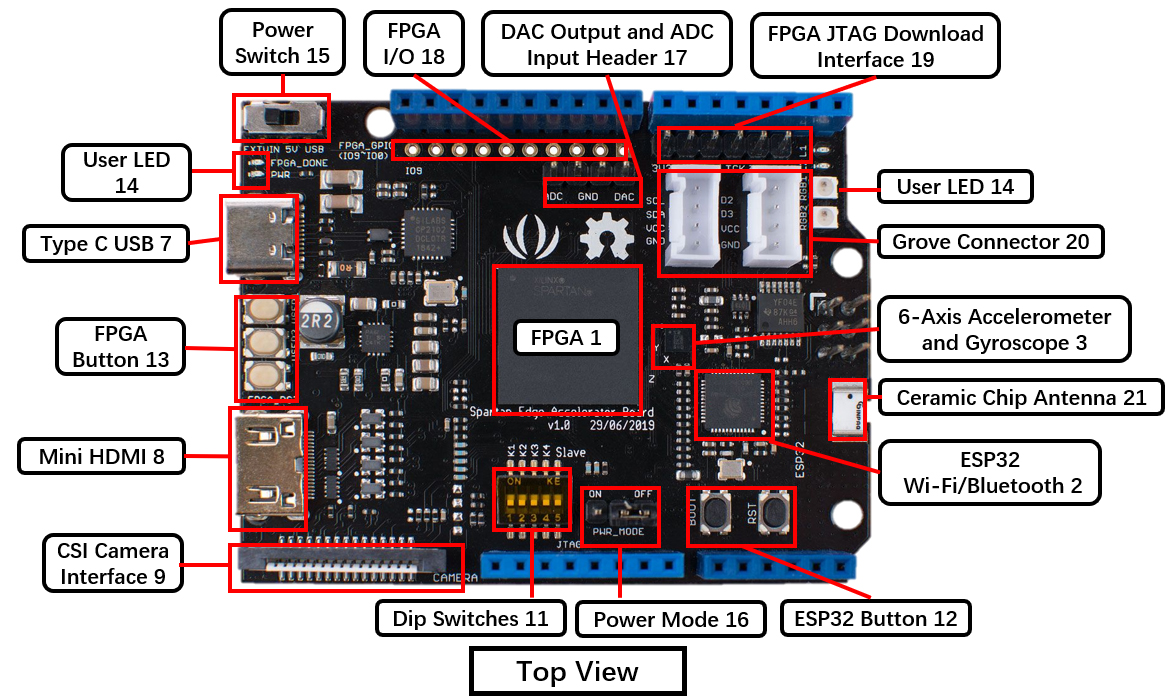
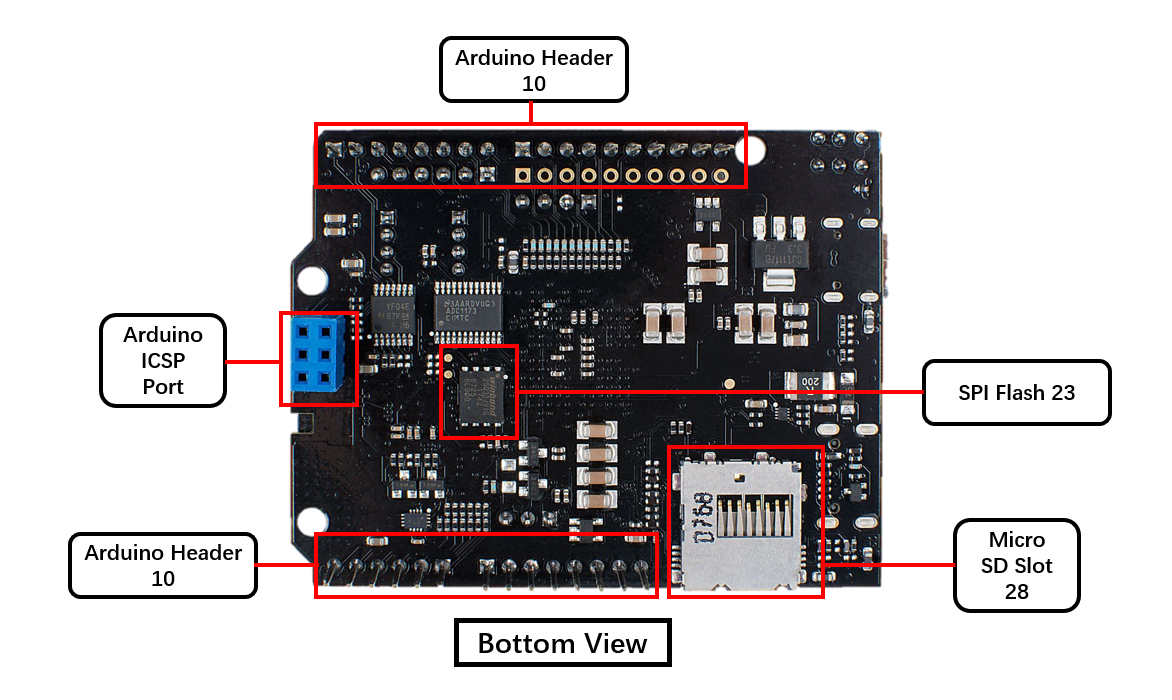
SEA Board Peripheral Descriptions and Locations
| 1 | FPGA : XC7S15-1FTGB196C | 11 | DIP Switchs | 19 | FPGA JTAG Download Interface |
|---|---|---|---|---|---|
| 2 | WiFi/Bluetooth : ESP32-D0WDQ6 | K1-K4 user switchs | 20 | Grove Connector : 1x I2C; 1x D2&D3 | |
| K5 Switch FPGA Programming Mode | |||||
| 3 | 6-axis Accelerometer and Gyroscope : LSM6DS3TR | ->>>> JTAG : Using Xilinx official Programming Tool | 21 | Ceramic chip antenna | |
| ->>>> Slave : Using ESP32 to Program the FPGA | |||||
| 4 | DAC : DAC7311IDCKR | 12 | ESP32 Button :Boot and RST | 22 | ADC : ADC1173 |
| 5 | Buck-DCDC : TPS62130 | 13 | FPGA Button :USER1 USER2 FPGA_RST | 23 | SPI Flash : W25Q32JVZPIG |
| 6 | USB-to-UART : CP2102-GMR | 14 | User LED: L1/L2/RGB1/RGB2 | 24 | Analog Switch :DG2788A |
| PWR : Power On | |||||
| FPGA_DONE : Light up after programming the FPGA with esp32. | |||||
| 7 | USB : Type-C | 15 | Power Switch : | 25 | LDO : XC6221B102MR |
| USB->Powered by USB Type C (5V DC) | |||||
| 5V->Powered by VIN Pin (8~17V DC) | |||||
| 8 | Mini HDMI | 16 | Power Mode: | 26 | LDO : RT9013-18GB |
| OFF->Isolate the power supply of Arduino and Shield | |||||
| ON->Connect Power of Arduino and Shield | |||||
| 9 | CSI Interface :MIPI Camera (compatible with Raspberry Pi Camera V1 - OV5640) | 17 | DAC Output and ADC Input Header | 27 | LDO : CJ1117-3V3 |
| 10 | Arduino Header : Compatible with Arduino UNO | 18 | FPGA IO : IO9~IO0 | 28 | SD card slot : Micro SD/TF card |
The following documentation guides you through the process for creating the FPGA designs on the SEA board with Xilinx's Vivado 2019.2 software.
Spartan Edge Accelerate Board Development Manual - FPGA Part
Spartan Edge Accelerate Board Development Manual - Experiment Part
Spartan Edge Accelerate Board Development Manual - ESP32 Part

Yongming Tang, researcher; member of SID, IEEE, CVS(China Vacuum Society), director of the Teacher Teaching Development Center of Southeast University. He has been engaged in the teaching of courses of electronic science and technology for many years, edited one textbook of "Building Your Digital Building Blocks” and translated one textbook. He created and organized of Southeast University PLD Design Competition and the National College Student FPGA Innovation Design Competition. He also won the second prize in National Teaching Achievement, one special prize for teaching in Jiangsu Province, one first prize, and won the second prize for each.
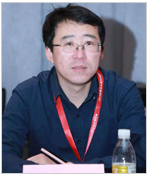
Zhixiong Di, Ph.D., Deputy Dean of the Department of Electronic Engineering, School of Information Science and Technology, Southwest Jiaotong University. In 2014, he graduated from Xidian University with a major in microelectronics, solid-state electronics. His research direction is high-performance image compression VLSI hardware system design and digital integrated circuit layout algorithm, and FPGA intelligent hardware design. He published multiple SCI/EI search papers and authorized more than ten Chinese invention patents. He served as the chairman of the 2020 CCF-DAC conference sub-forum. He has served as the judge of the finals of disciplines such as the China Postgraduate Electronic Design Competition, the China Postgraduate Innovation "Core" Competition, and the National Undergraduate FPGA Innovation Design Competition.









 Netherlands