






 Instellingen
 Snelle levering
 Gratis verzending
 Incoterms
 Betalingswijzen


 Marketplace-product

Diplexers Shrink to Meet Complex Multiband Wireless Needs
Bijgedragen door Electronic Products
2015-02-26
As multiband smartphones, which must support different frequency bands, become more common, the diplexer is an increasingly important passive component. This multiband bandpass filter is placed between the antenna and the electronics of the wireless unit, allowing multiple transmit power amplifiers and receiver front-ends to support the different bands yet share a common antenna path.
On the receiver side, the diplexer takes two signals from the antenna (often called high- and low-band signals) and directs them to the appropriate receiver front-end; on the transmit side, it combines the signals from two output power amplifiers in different bands before they go to the antenna (Figure 1). The technology and associated implementation of modern diplexers is closely related to SAW filters and other monolithic, solid-state filters.
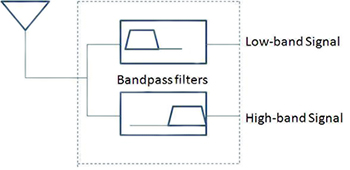
Figure 1: A basic diplexer consists of co-packaged low- and high-band bandpass filters, to split/combine two adjacent bands so they can share a single antenna.
Some diplexer architectures are based on a simple pairing of a low-pass filter and a high-pass filter to separate the two bands of interest. These implementations usually need additional bandpass filtering to further attenuate signals outside the spectrum of the signals of interest (Figure 2). While the combined low-pass plus bandpass filter approach has more functional blocks than a bandpass-only topology, this pairing may ease the challenge of designing filters that meet the overall requirements and so can be less costly along with offering better performance, depending on the specifics of the situation.
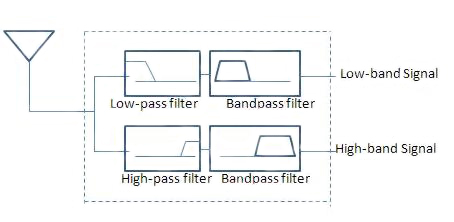
Figure 2: Some diplexers use low- and high-pass filters in conjunction with bandpass filters, which add to the internal complexity, but may actually simplify the design and improve performance.
The diplexer is a three-port passive device, and the same device can be inserted for either the receiver or transmitter paths. It's important that the diplexer presents a defined input or output impedance to the front-end, power amplifier, and antenna to achieve proper interstage matching.
Also note that the term diplexer and splitter are sometimes used interchangeably in casual conversation, but they are often different. A true splitter takes a single signal and divides it equally along two paths (the power to each leg is half compared to the original signal strength), so the source can feed multiple receivers; an example is a cable feed going to two separate TVs.
However, some splitters really act as diplexers, such as those which take a single broadcast TV-antenna signal and split it into VHF and UHF bands. The complement is true as well: a combiner takes two signals at the same frequency and feeds them to a common output, but some combiners are actually diplexers, such as those which take the output from VHF and UHF antennas and combine them to go onto a single cable. Therefore, when talking about diplexers, splitters, and combiners, it's a good idea to clarify the terms.
While the two-band diplexer is the most common combining/splitting configuration, there are also three-band triplexers and even four-band quadplexers; while these tend to have reduced performance specifications and much higher cost than diplexers, they may be the most cost-effective, space-saving approach.
Diplexer versus duplexer
Note that a diplexer is not the same as a duplexer. Like a diplexer, the duplexer is placed between the system antenna and its electronics (the receive-path input amplifier, and the transmit-path power amplifier). However, the function of the duplexer is to separate transmit and receive signals, which occupy the same band, from each other; this separation is needed during full-duplex or even half-duplex operation. By controlling the flow of input and output energy so the relatively high-power output does not reach, overload, and even possibly damage the sensitive receiver-side input, the duplexer couples the transmitter and receiver to the antenna while providing isolation between transmitter and receiver.
Although it may seem simpler just to separate the transmitter and receiver functions into separate parts of the spectrum, this is often not possible. For example, a radar system transmits a relatively high-power signal, and then shifts to receiver mode to catch the faint echo reflection; both signals are at the same frequency (except for Doppler shift, if any). If the receiver were left connected to the antenna during the transmit phase, the transmitter signal would overload the receiver front-end and drive it into saturation, thus disabling its ability to function until the front-end recovers. Depending on power levels, the transmit signal's power would likely permanently damage the receiver’s sensitive front-end. In contrast to the duplexer, the diplexer is a multiband unit, intended for use where transmit and receive functions occupy different parts of the spectrum and so can be separated by bandpass filtering.
Diplexer design and parameters
Low-power diplexers used at lower frequencies, under about 500 MHz, are built using discrete components on PC boards (Figure 3). Diplexers for higher frequencies and higher-power levels, on the order of 1 GHz/10 W and above, are usually built as modules or hybrid devices using higher-performance RF components. However, for low-power portable-device applications above 1 GHz such as Wi-Fi, smartphones, and GPS receivers, where the power levels are under several watts, designers use monolithic diplexers based on SAW (surface acoustic wave) and FBAR (film bulk acoustic resonator) technologies.
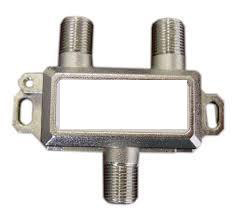
Figure 3: A low-cost, standard diplexer used to combine UHF and VHF broadcast TV signals onto a single cable; the same unit is used at the other end of the cable to split them to individual tuners at the TV set input.
Since diplexers are specialized forms of filters, the conventional filter parameters are used to characterize them. These include well-known filter factors such as center frequency, bandwidth, insertion loss, attenuation, power handling, and temperature stability.
Diplexers have an additional key performance parameter: the resultant isolation between the low and high bands. This number goes beyond the characterization of the filter roll-off outside the passband; instead, it is a function of the roll-off of those low and high passbands and how close the two passbands are to each other. As a result, it defines how much the signals in one band will be attenuated with respect to the other band. Some vendors explicitly specify the isolation; for those cases where they do not, designers can determine it by overlapping the bandwidth and insertion-loss graphs for the high and low bands.
A representative diplexer is the TDK DPX165950DT-8126A1, a multilayer chip unit for 2.4 GHz and 5.0 GHz wireless LAN (WLAN) bands. Isolation between the low band and high band is better than 30 dB (Figure 4). Low-band insertion loss (2400 to 2496 MHz) is 0.6 dB (maximum), and corresponding high-band insertion loss (4900 to 5950 MHz) is 1.4 dB (maximum); typical values are about half those numbers. Both low- and high-band port filters have sharp roll-offs, as shown in Figure 5 and Figure 6, respectively. The device is tiny, measuring just 1.6 × 0.8 × 0.6 mm high.
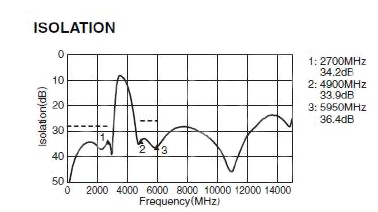
Figure 4: The TDK DPX165950DT-8126A1 diplexer for 2.4/5.0 GHz bands provides isolation of at least 30 dB between the low band and the high band.
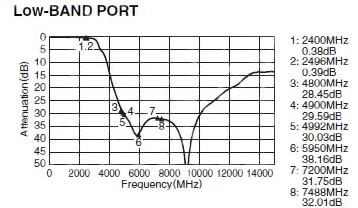
Figure 5: For the TDK component, low-band insertion loss in the passband is about 1 dB while high-band insertion loss is a little over 1 dB (typical).
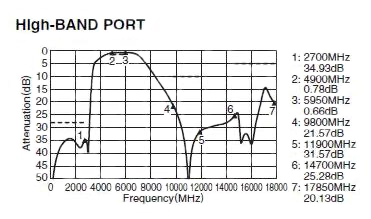
Figure 6: Attenuation outside the passband for each bandpass filter is at least 10 to 15 dB for the TDK diplexer.
Another interesting part is in the 2450DM40A1575 family from Johanson Technology, a 2.5 × 2.5 × 1.2 mm-high component. This diplexer is designed to separate the nominal 2.4 GHz ISM (industrial, scientific , and medical) band used for Bluetooth, 802.11 (Wi-Fi), ZigBee, or proprietary WLANs in that band from the nominal 1.5 GHz GPS signal, as would be needed in a combined LAN-based product which must also geolocate using an independent GPS function.
To enhance performance, the device includes SAW and LC bandpass filters in addition to the up-front diplexer block (Figure 7). The GPS portion has a narrow bandwidth of about 100 MHz, with insertion loss of more than 40 dB outside the passband (Figure 8). In contrast, the WLAN portion has a wider bandwidth of several hundred MHz, with a more gradual insertion-loss roll-off (Figure 9) and a maximum insertion loss of about 40 dB.
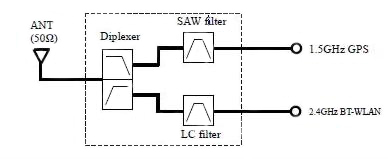
Figure 7: The 2450DM40A1575E from Johanson Technology separates a 2.4 GHz wireless LAN band from the GPS carrier frequency.
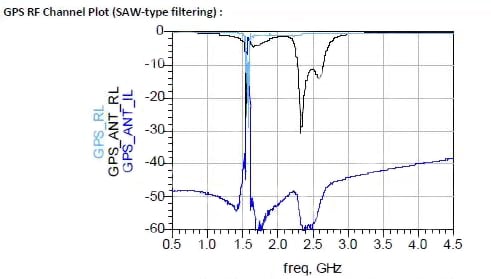
Figure 8: The GPS band requires a narrow passband with sharp roll-off to select the GPS signal while attenuating nearby potential interfering signals.
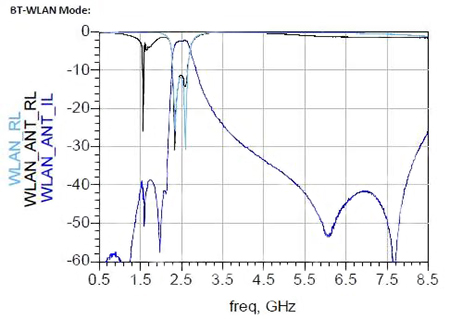
Figure 9: For the wireless LAN portion of the spectrum, the 2450DM40A1575E passband is wider and the roll-off is more gradual.
These are just two examples among many units available, each tailored to different parts of the spectrum and application pairings. Among the other vendors offering diplexers that can be found on the DigiKey website are Avago Technologies, AVX, M/A Com, Taiyo Yuden, and YAGEO.
Summary
Diplexers are needed for multiband operation in wireless devices, such as 2.4/5 GHz smartphones, or wireless LANs which include an auxiliary function such as a GPS receiver. By separating an incoming signal via bandpass filters into two (or more) constituent bands, or combining multiple bands into a single signal, one antenna can serve the needs of multiple front-ends/power amplifiers. For low-power devices, diplexers can be fabricated using monolithic SAW or FBAR technologies, which offer very good performance in tiny, low-cost packages.
For more information on the parts discussed in this article, use the links provided to access product pages on the DigiKey website.
Disclaimer: The opinions, beliefs, and viewpoints expressed by the various authors and/or forum participants on this website do not necessarily reflect the opinions, beliefs, and viewpoints of DigiKey or official policies of DigiKey.










 Nederland