Instellingen
 Snelle levering
 Gratis verzending
 Incoterms
 Betalingswijzen


 Marketplace-product

Regulatory Trends Pose New Challenges for LED Lighting Designers
Bijgedragen door De Noord-Amerikaanse redacteurs van DigiKey
2017-11-14
Traditional considerations such as thermal management, footprint, and cost have always played a fundamental role in an LED lighting designer’s decision to select specific components and make architectural decisions. However, they also must now anticipate increasingly stringent worldwide regulatory requirements for performance characteristics such as power factor, total harmonic distortion, and power efficiency.
To meet these requirements, designers need a new generation of LED drivers. This article will look at anticipated changes in the regulatory environment for LED lighting and how those changes are driving topology and operating mode selection in next-generation lighting solutions.
Ever-changing LED power regulations
Regulatory agencies are tightening up requirements for LED lighting. As an example, driver manufacturers typically use power factor correction (PFC) circuitry to maximize power quality and meet evolving requirements. Today, agencies require PFC to be > 0.9 for designs of > 5 watts (W) at nominal line voltage; and requirements are expected to become increasingly stringent.
Total harmonic distortion (THD) requirements are on a similar track. While there are no specific requirements for light bulbs at present, they are likely to emerge in the near future as LED lights rapidly replace older technologies. In the meantime, agencies around the world already require < 25% THD for Class C lighting applications > 25 W. Some regulatory agencies are pushing that specification down to < 10%, particularly as the impact of lower quality power on the grid becomes increasingly apparent.
Power efficiency is a moving target as well. Regulatory agencies have set some basic standards for systems with power levels < 20 W. As an example, a non-dimmable power supply must be at least 85% efficient across nominal line voltages, but the introduction of dimming complicates the issue. Line voltage dimming almost always increases THD and reduces efficiency. Indicative of that, regulatory agencies reduce requirements for lighting applications using phase-modulated dimming because dimming circuitry requires external components that run at a fixed loss. It seems a safe assumption that regulatory requirements for power efficiency in LED lighting will move higher in the near future.
Conduction modes
To meet demand for smaller, more reliable and lower cost devices, driver manufacturers offer products that usually feature PFC circuitry for higher power quality, primary-side regulation (PSR) to eliminate the cost, and use a single-stage flyback topology to simplify design, including the elimination of the bulk capacitor to save space (Figure 1). PSR can play a key role in helping LED driver manufacturers meet international regulations for solid-state lighting (SSL) by controlling the output current precisely with the information in the primary side of the power supply, removing output current sensing loss, and eliminating secondary feedback circuitry. This allows the manufacturer to fit the driver circuit in compact retrofit lamps and meet regulations at low cost.
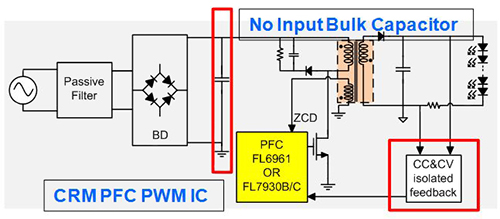
Figure 1: A traditional single-stage flyback PFC solution using a CRM PFC control IC that was originally designed for boost PFC applications can perform well as a single-stage flyback solution with some circuit modifications. This approach offers high efficiency, but requires a fast turn-on circuit or the VCC start-up resistor will incur losses. (Image source: ON Semiconductor)
Usually this single-stage flyback PFC solution incorporates a critical conduction mode (CRM) control IC that operates with a fixed on time, variable off time. This approach offers excellent constant current or constant voltage regulation at the output, but the control IC was originally intended for boost PFC applications, not single-stage flyback applications. Designers can add circuit modifications for load control and a fast start circuit to achieve reasonable efficiencies and improve PF and THD. However, the CRM topology brings with it inherent characteristics that impose performance limits on PF, efficiency and THD. Moreover, this approach adds additional components that drive up cost.
As an alternative, designers can opt to use the Discontinuous Conduction Mode (DCM) PFC approach. Instead of using a variable frequency and variable duty cycle, the DCM mode operates with a fixed on-time and fixed frequency for any given load configuration. This operating mode eliminates some of the limitations typically associated with the CRM approach, most importantly its limited headroom for improved THD and PF. In a flyback topology, controllers like ON Semiconductor’s FL7733A can support constant turn-on time and constant frequency in DCM operation, and achieve higher PF and lower THD than comparable CRM solutions.
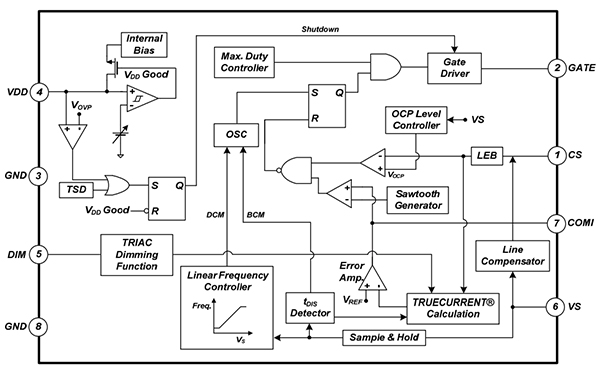
Figure 2: Flyback topology controllers like ON Semiconductor’s FL7733A can support constant turn-on time and constant frequency in DCM operation, and achieve higher PF and lower THD than comparable CRM solutions. (Image source: ON Semiconductor)
Optimized for single-stage flyback PFC constant current regulated LED applications, the FL7733A has a highly integrated pulse width modulation (PWM) controller with an advanced PSR technique to minimize components on low to mid-power LED lighting converters. It has tight tolerance and constant current output over all conditions (+/- 3%). It also helps meet what are becoming increasingly stringent LED brightness requirements, with a tolerance of less than +/- 1 % over the universal line voltage range. LED current remains accurate regardless of input voltage, output voltage, or magnetizing inductance variations.
From a regulatory point of view, the FL7733A’s DCM operation mode allows designers to meet very stringent PF and THD requirements. Constant turn-on time and constant frequency in the DCM operation mode helps to achieve a high PF of > 0.9 and a low THD of < 10% over the universal line input range. Turn-on time is managed by the internal error amplifier and a large external COM1 capacitor (typically > 1 µF) at the COM1 pin. Constant frequency and DCM operation are managed by DCM control.
The FL7733A controller also has fast startup of < 200 milliseconds (ms) at 85 VAC using an internal high voltage startup with VDD regulation. A variety of protection circuits provide LED open/short, sensing resistor short/open, overcurrent, overtemperature, and cycle-by-cycle current limitation protection. It operates over an application input range of 80 VAC to 308 VAC.
An advantage of the DCM approach is that it allows designers to implement circuitry elements that reduce startup time and power loss caused by the startup resistors typically used in a CRM power supply. However, there is a downside. While operating in DCM, the DC conversion ratio is dependent upon load complicating DC analysis. Ringing is also a potential problem with DCM, and since RMS and peak currents are higher, the transformers must be larger to accommodate greater flux swings and larger copper and core losses. This controller also helps drive down cost by eliminating the input electrolytic capacitor, an optocoupler and a regulator.
General low-to-mid-power lighting control
For general low-to-mid-power lighting applications requiring PFC and EMC compliance, devices like Texas Instruments’ UCC28810/11 can be used to efficiently control flyback, buck or boost converters operating in Critical Conduction Mode. Key features in these controllers include a transconductance voltage amplifier for feedback error processing, a simple current reference generator for creating a current command proportional to the input voltage, a current-sense comparator, PWM logic, and a totem-pole driver to drive an external FET.
The UCC28810/11 offers a wide array of features designed to reduce power consumption and maximize system efficiency. When operating in critical conduction mode the PWM circuit is self-oscillating. Turn-on is managed by a transformer-based zero energy detector, and turn-off is controlled by the current-sense comparator.
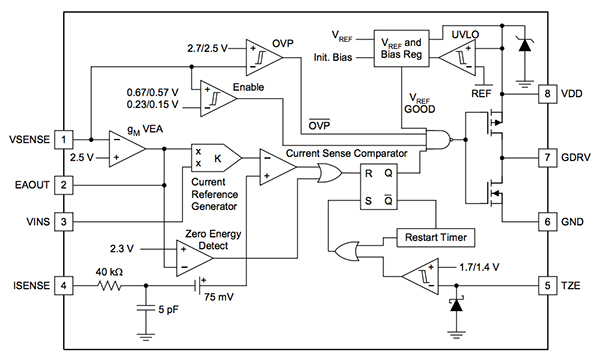
Figure 3: Texas Instruments’ UCC28810/11 LED lighting power controller combines a transconductance amplifier for feedback error processing, a current-sense comparator, PWM logic and a totem-pole driver to drive an external FET. (Image source: Texas Instruments)
To improve system efficiency, the UCC28810/11 adds a zero-power detect function that shuts down the controller output in light load conditions. A slew rate enhancement circuit improves large signal transient performance of the voltage error amplifier. As a result, the device’s relatively low start-up and operating currents help minimize power consumption. At the same time, the device’s internal bandgap reference helps ensure high reliability by delivering accuracy high enough to ensure tight regulation of the output voltage in normal and OVP conditions.
The controller comes in two versions. The only differences between the two devices are different UVLO turn-on thresholds and gM amplifier source current. The UCC28810 features a UVLO turn-on threshold of 15.8 volts and a gM amplifier source current of 1.3 mA typical. The UCC28811 has a UVLO turn-on threshold of 12.5 volts and a gM amplifier source current of 300 µA (Typ).
The UCC28810’s higher UVLO turn-on threshold supports faster and easier startup with a smaller VDD capacitance, while the UCC28811’s lower UVLO turn-on threshold allows the operation of the CCM controller to be managed by a downstream PWM controller in two-stage power converters. Having a smaller VDD capacitor and enhanced transient response, the UCC28810 is optimized for commercial and residential retrofit lighting applications that have no downstream PWM conversion. The UCC28811 is primarily targeted at streetlight and other large area lighting applications where two-stage power conversion is commonly used.
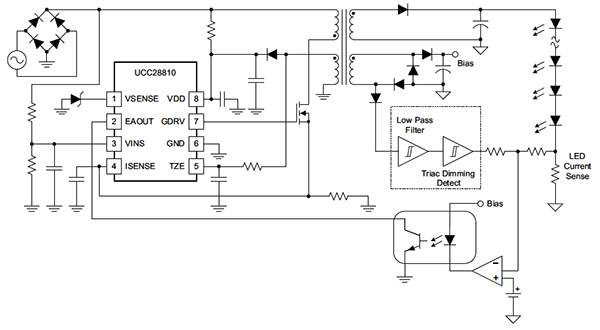
Figure 4: A simplified diagram using UCC28810 shows the main elements needed for operation as a general lighting power controller for low-to-medium power lumen applications requiring PFC and EMC compliance. It interfaces to traditional wall dimmers. (Image source: Texas Instruments)
Conclusion
Today’s LED lighting designers face a constantly moving target. On the one hand, they must optimize their solutions for traditional considerations such as thermal management, footprint and cost. At the same time, they must anticipate increasingly stringent worldwide regulatory requirements for performance characteristics such as PF, THD and power efficiency. New generations of LED drivers are helping them meet these challenges.

Disclaimer: The opinions, beliefs, and viewpoints expressed by the various authors and/or forum participants on this website do not necessarily reflect the opinions, beliefs, and viewpoints of DigiKey or official policies of DigiKey.