Instellingen
 Snelle levering
 Gratis verzending
 Incoterms
 Betalingswijzen


 Marketplace-product

Resistor-Integrated Microswitches Improve System Reliability Through Four-State Detection
Bijgedragen door De Noord-Amerikaanse redacteurs van DigiKey
2026-04-21
Microswitches are critical in industrial machinery, automation systems, and consumer devices, where they facilitate reliable operation by detecting position and initiating control actions. These electromechanical components enable status detection, safety interlocking, and limit control, all essential for system protection and equipment reliability.
In status detection and feedback roles, microswitches act as position sensors, confirming that a component has reached a specific state or location. For example, a microswitch may confirm that a removable panel or component has been correctly installed within a system. They are also common in safety interlocks, where they prevent equipment from operating unless predefined physical conditions are satisfied. In industrial equipment, for instance, a microswitch may ensure that a safety guard is fully closed before a machine can start.
A third key function is limit control. In mechanical systems, microswitches define the end-of-travel for moving components. Once a moving part reaches its limit position, the switch signals the control system to stop the actuator or motor, preventing mechanical overtravel or damage.
Due to these critical functions, microswitches are widely deployed across numerous systems, including factory robots, smart meters, home appliances, vending machines, and security equipment.
Conventional microswitch limitations
Despite their widespread use, conventional microswitches have fundamental limitations for fault detection and diagnostics, particularly in safety-sensitive or mission-critical systems. Traditional microswitches operate using a two-state signaling scheme, producing only two possible outputs, open or closed. While this is sufficient for basic switching tasks, it does not provide the connected controller with any information about the health of the switch circuit itself.
If a wire breaks, creating an open circuit, the controller may interpret this as a legitimate “open” switch state. Conversely, a short circuit may be misinterpreted as a valid “closed” condition. In both cases, the system receives a signal that appears correct even though a fault has occurred. As a result, the system is unable to distinguish between a valid switch state and faults.
This inability to differentiate between normal and abnormal operation can lead to several operational challenges. Faults may remain undetected until a functional failure occurs, resulting in unexpected system downtime. When failures do occur, diagnosing the root cause requires technicians to physically inspect the installation, significantly increasing maintenance time and cost.
The problem is particularly significant in remotely deployed or unattended systems, such as security installations, vending machines, smart metering infrastructure, and autonomous mobile robots. In these environments, operators rely on remote monitoring to detect tampering or faults. Without remote fault monitoring and diagnostic capability, critical system failures remain hidden until they cause operational or security compromise.
For safety interlock systems, this limitation is critical. A conventional microswitch can only indicate switch states. It cannot diagnose whether the wiring and signal path remain intact. A fault between the switch and controller leaves the safety system blind to the failure, potentially allowing unsafe operation to proceed undetected.
Given the implications of these issues and the increasing emphasis on reliability and safety in modern industrial systems, the lack of self-diagnostic capability in conventional microswitches has become a significant design constraint.
Historically, system designers have addressed these limitations by implementing external fault-detection mechanisms, such as dual-channel redundancy or additional resistor networks integrated into the switching circuit. However, these approaches introduce additional components, increase assembly complexity, and may still fail to detect faults between the controller and the switch.
Four-state detection using integrated resistor microswitches
To overcome the diagnostic limitations of conventional microswitches without additional components, wiring complexity, or assembly effort, system designers are implementing a simple, effective solution: resistor-integrated microswitches.
In standard designs, a switch connects to a microcontroller input pin via a simple two-wire connection, either through a wiring harness or PCB traces, depending on the system architecture. The controller interprets the switch state using a basic digital input configuration.
When the switch closes, the input is pulled toward the supply voltage (Vcc) and the controller registers a logic high. When the switch is open, the input is pulled toward ground, and the controller reads a logic low. Because the controller monitors only the resulting two logic levels, it cannot determine whether the signal reflects a legitimate switch state or an electrical fault, and therefore cannot self-diagnose.
Resistor-integrated microswitches solve this by embedding precision resistors directly into the switch assembly. Rather than reporting only two voltage states, the integrated resistors generate four distinct output voltages corresponding to four circuit conditions:
- Switch ON (Normally Closed), State 1: When the switch is pressed and the contacts close, one resistor path completes the circuit, producing a specific voltage.
- Switch OFF (Normally Open), State 2: When the switch is released and the contacts open, a different resistor is activated, producing a distinct, lower voltage.
- Open Circuit, State 3: If the wiring between the switch and controller is severed or a connector corrodes, the circuit remains open regardless of switch position. The integrated resistors produce a third characteristic voltage. External resistor configurations in conventional switches cannot reliably detect this condition, as a fault between the resistor and the switch is indistinguishable from the normal open state, rendering it invisible to the controller (Figure 1).
- Short Circuit, State 4: If the harness shorts to ground, the circuit is forced to ground potential. The integrated resistor configuration produces a characteristic voltage distinct from those of states 1, 2, and 3.
 Figure 1: An illustration of the difference in fault detection in a resistor-integrated microswitch versus a conventional switch with external resistors (Image source: Omron)
By sampling the voltage output and comparing it against four expected reference values, a microcontroller can identify not only the switch position but also the integrity of the switch-to-controller circuit. This self-diagnosis capability provides significant advantages across reliability, maintenance, design efficiency, and safety:
- Rather than remaining hidden during normal operation, faults such as broken wires or short circuits are detected immediately. This remote fault monitoring enables systems to identify abnormal conditions automatically and trigger alarms or shutdown procedures.
- Maintenance personnel can remotely diagnose issues by electronically monitoring abnormal states, eliminating the need for physical inspection.
- Integrating resistors into the switch simplifies wiring, reducing component count, PCB space requirements, and assembly time and effort.
Electronics manufacturers offer resistor-integrated microswitches for applications where reliability, fault detection, and remote monitoring are critical, including factory automation systems, smart infrastructure, security installations, and autonomous equipment. One leading example is Omron.
Omron's resistor-integrated microswitches
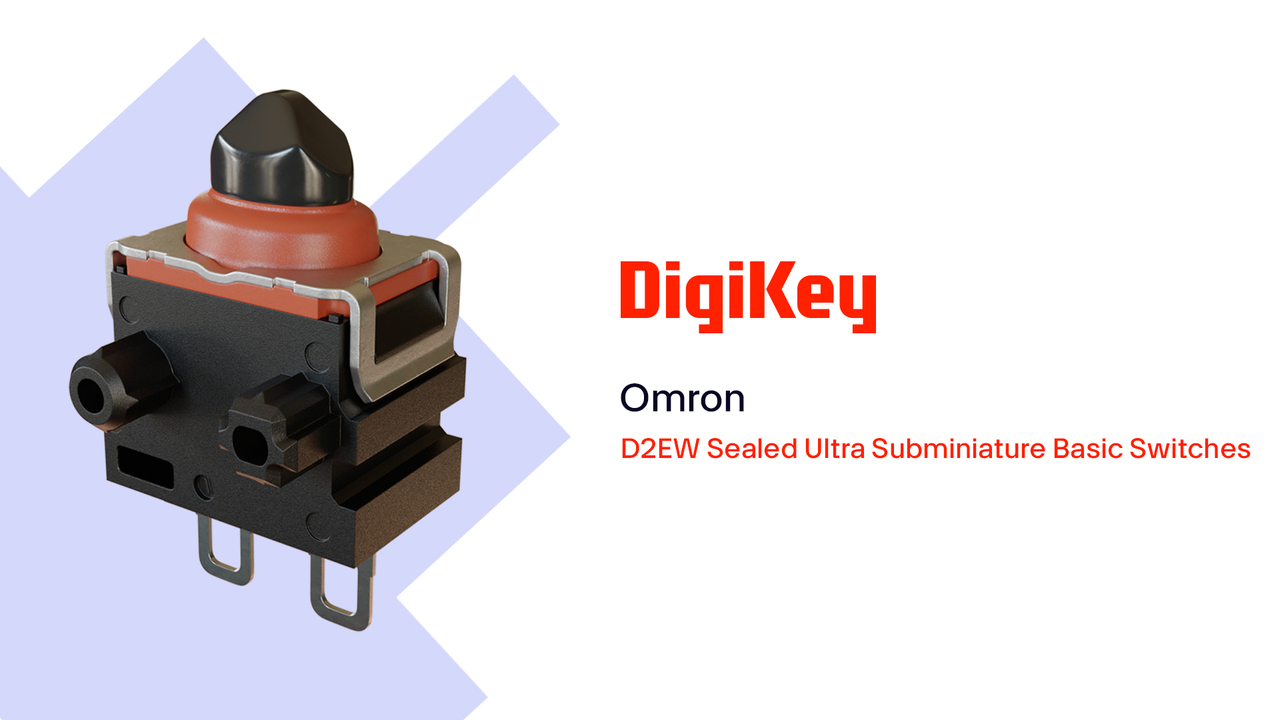
Omron's D2EW-R line of resistor-integrated microswitches enables four-state detection and self-diagnostics, improving system reliability while simplifying wiring and circuit integration. The line is an integrated-resistor variant of the D2EW ultra-subminiature sealed microswitch family, bringing four-state diagnostic capability into the industry's smallest class of switches, measuring 8.3 mm × 7.0 mm × 5.3 mm. This compact form factor makes them suitable for space-constrained designs and compact electronic assemblies.
Furthermore, because the D2EW-R maintains the same footprint as Omron's original D2EW design, engineers can retrofit four-state fault detection into existing applications without redesigning the mechanical structure.
Omron offers the D2EW-R self-diagnostic microswitch in multiple configurations that primarily differ in internal circuit structure, terminal type, and mounting. The D2EW-R1-B03L and the D2EW-R5-B03L (Figure 2) both feature long press-fit terminals and post mounting but have series and parallel resistor configurations, respectively.
 Figure 2: The D2EW-R5-B03L provides reliable four-state detection in a compact, sliding contact design. (Image source: Omron)
All D2EW-R models feature sealed IP67-rated construction with an operating temperature range of -40°C to +85°C, enabling reliable operation in extreme environments. Rather than relying on spring-return mechanisms, these microswitches use a sliding-contact design, in which the plunger translates laterally when pressed. This geometry delivers smooth, quiet actuation and more evenly distributed contact loading, contributing to a rated mechanical lifetime of 300,000 operations. Furthermore, the integrated resistor microswitch provides robust resistance to vibration and shock, making it suitable for harsh factory automation, security, and mobility environments.
Conclusion
Modern industrial, remote, security, and autonomous systems require reliability beyond the on/off detection provided by conventional microswitches. Resistor-integrated microswitches address this limitation by embedding resistors directly into the switch, enabling detection of four distinct circuit states and supporting advanced diagnostics. This capability simplifies wiring, reduces component count, and improves system reliability.

Disclaimer: The opinions, beliefs, and viewpoints expressed by the various authors and/or forum participants on this website do not necessarily reflect the opinions, beliefs, and viewpoints of DigiKey or official policies of DigiKey.